
Home Multi-Country Search About Admin Login
Cenozoic
Mesozoic


Information provided by geoscience team at Ahmadu Bello University, Zaria, Nigeria --see About

Search by
Select Region(s) to search
Hold Ctrl (Windows/Linux) or Command (Mac) to select multiple
Kubla Formation
Click to display on map of the Ancient World at:
Kubla Fm base reconstruction

Kubla Fm


Period: 
Cretaceous

Age Interval: 
Barremian


Province: 
Chad S

Type Locality and Naming

Bongor Basin (SW Chad). Outcrops in the east and west of the basin

Reference: Chen et al., 2018; Wang et al., 2022; Dou et al., 2023

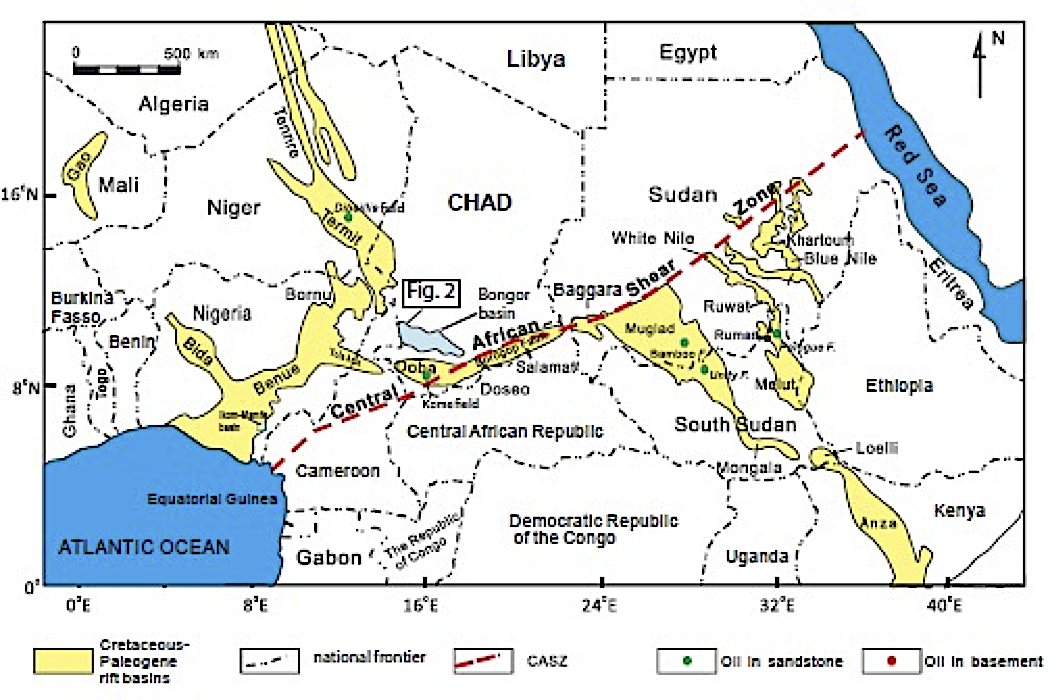
[Fig. 1: Simplified map of the West and Central African Rift System (WCARS) showing the major features discussed in the text and the location of the Melut Basin in South Sudan (modified from Genik, 1993)]

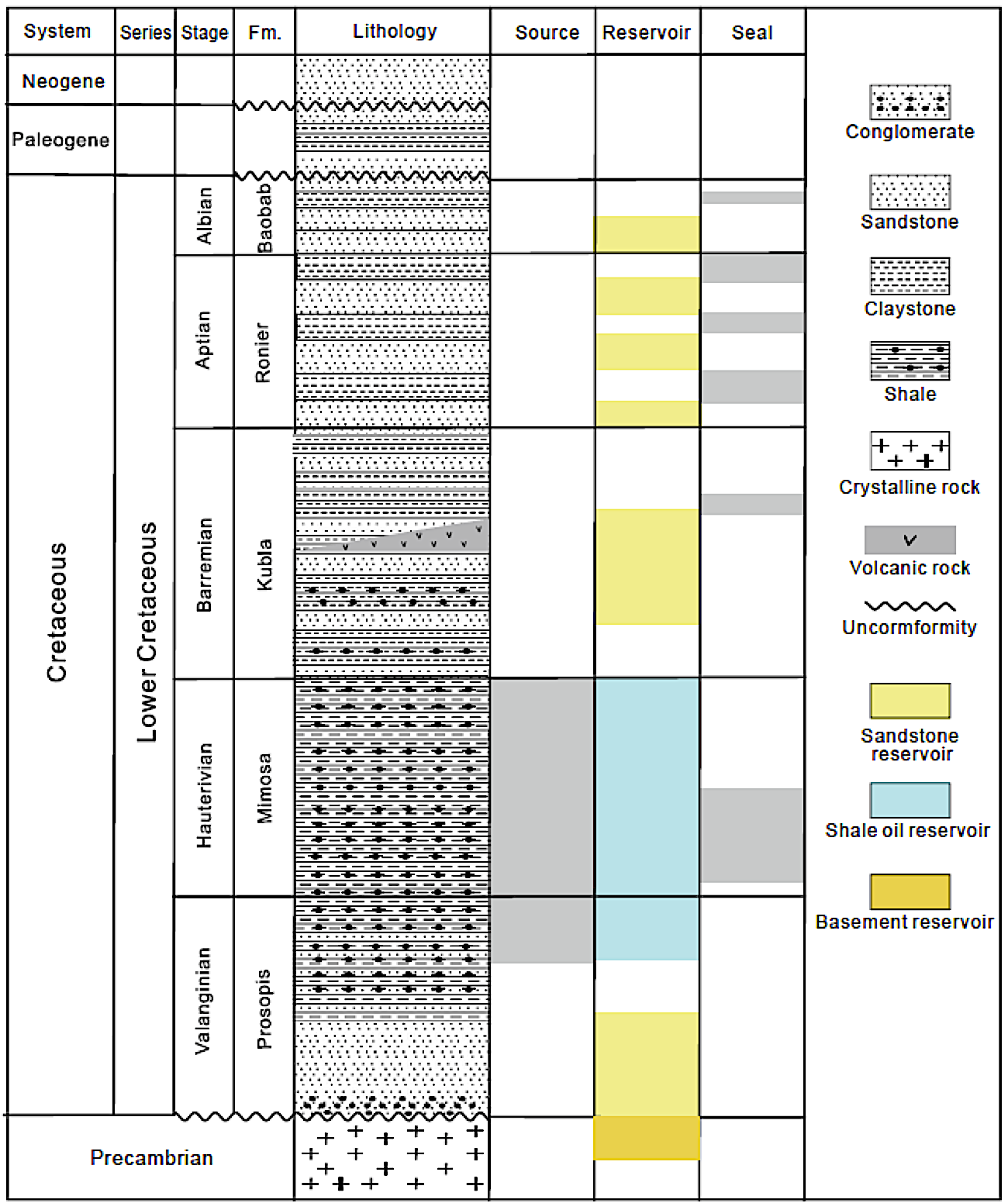
[Fig. 2: Stratigraphic chart for the Bongor Basin showing the positions of producing reservoirs, source rocks and seals (from Dou et al., 2020)]
Lithology and Thickness

The lower part is composed of a large set of fine sandstone to gritstone, interbedded with mudstone and shale, and the upper part primarily contains shale, siltstone, and fine sandstone, with local reverse cycle deposits of fine sandstone to gritstone (Dou et al., 2023). Lower part of the formation is made up of thin- to medium-bedded, fine- to medium-grained sandstones interbedded with grey mudstones. Upper part of the formation is made up of thick-bedded, massive medium- to coarse-grained sandstones, fine-grained sandstones interbedded with medium- to thick-bedded grey mudstones and black basalt (Chen et al., 2018; Wang et al., 2022). The thickness of the Kubla Formation varies a little between the east and west of the basin. The maximum thickness is 1300 m. The lithology is coarse in the west and fine in the east.


Lithology Pattern: 
Clayey sandstone


Relationships and Distribution

Lower contact

The Kubla Fm conformably rests on the Mimosa Fm

Upper contact

The Ronier Fm conformably rests on the Kubla Fm

Regional extent

Bongor Basin (SW Chad).


GeoJSON

{"type":"Feature","geometry":{"type":"MultiPolygon","coordinates":[[[[19.4,9.82],[17.92,9.36],[17.18,9.44],[15.36,9.97],[14.78,10.73],[15.25,11.38],[16.26,11.23],[17.7,10.81],[19.4,9.82]]]]}}

Fossils

Pollens (Leiotriletes, Concavisporites, Cyathidites minor, Lygodiumsporites subsimplex, Pilosisporites, Cicatricosisporites subrotundus, Cicatricosisporites gushanensis Li, Cicatricosisporites gracilis, Cicatricosisporites exilioides, Cicatricosisporites augustus Singh, Cicatricososporites potomacensis, Cicatricososporites, Interulobites triangularis, and Schizaeoisporites), Ostracods (Cypridea cf. yabulaiensis, C. cf. simplex, Mongolianella sp., Trianulicypris sp. Darwinula sp.,)


Age 

Barremian

Age Span: 

    Beginning stage: 
Barremian

    Fraction up in beginning stage: 
0.0

    Beginning date (Ma): 
126.50

    Ending stage: 
Barremian

    Fraction up in the ending stage: 
1.0

    Ending date (Ma):  
121.40

Depositional setting

Fan Delta (Chen et al., 2018; Wang et al., 2022).


Depositional pattern:  


Additional Information


Compiler:  

Enam O. Obiosio, Solomon Joshua Avong and Henry Nasir Suleiman (2024) - Stratigraphic Lexicon compiled from the following books:

Chen L., Ji H., Dou L., Du Y., Xu Z., Zhang L. (2018): The Characteristics of Source Rock and Hydrocarbon Changing Time of Precambrian Granite Reservoirs in the Bongor Basin, Chad. Mar. Petroleum Geol. 97, pp. 323-338

Wang Y., Xu G., Zhou W., Liang J., He S. (2022): Predicting Granitic Buried-Hill Reservoirs Using Seismic Reflection Data – A Case Study From the Bongor Basin, Southwestern Chad. Frontiers in Earth Science, pp. 1-13

Dou L., Xiao K., Wang J. (2023): Petroleum Geology and Exploration of the Bongor Basin. Petroleum Industry Press.